Thailand Tax for Remote Workers: Status, Permit, Residency
Remote work in Thailand raises three separate questions. The Decree bans working without a permit, with a fine of THB 5,000–50,000. A person in Thailand 180 days or more in a year is a tax resident. Foreign income earned from 2024 is taxed once a resident brings it in.
On this page
A laptop on a desk in Nimman, paid by an employer in another country. Three questions apply.
Each has its own answer. What does the work rule say about your status? Are you a Thai tax resident? Is the money taxed when it arrives?
Which status are you working on?
Visa-exempt entry is for tourism purposes only. The Destination Thailand Visa (DTV) is issued to people who want to travel and work remotely in Thailand, such as freelancers and digital nomads.
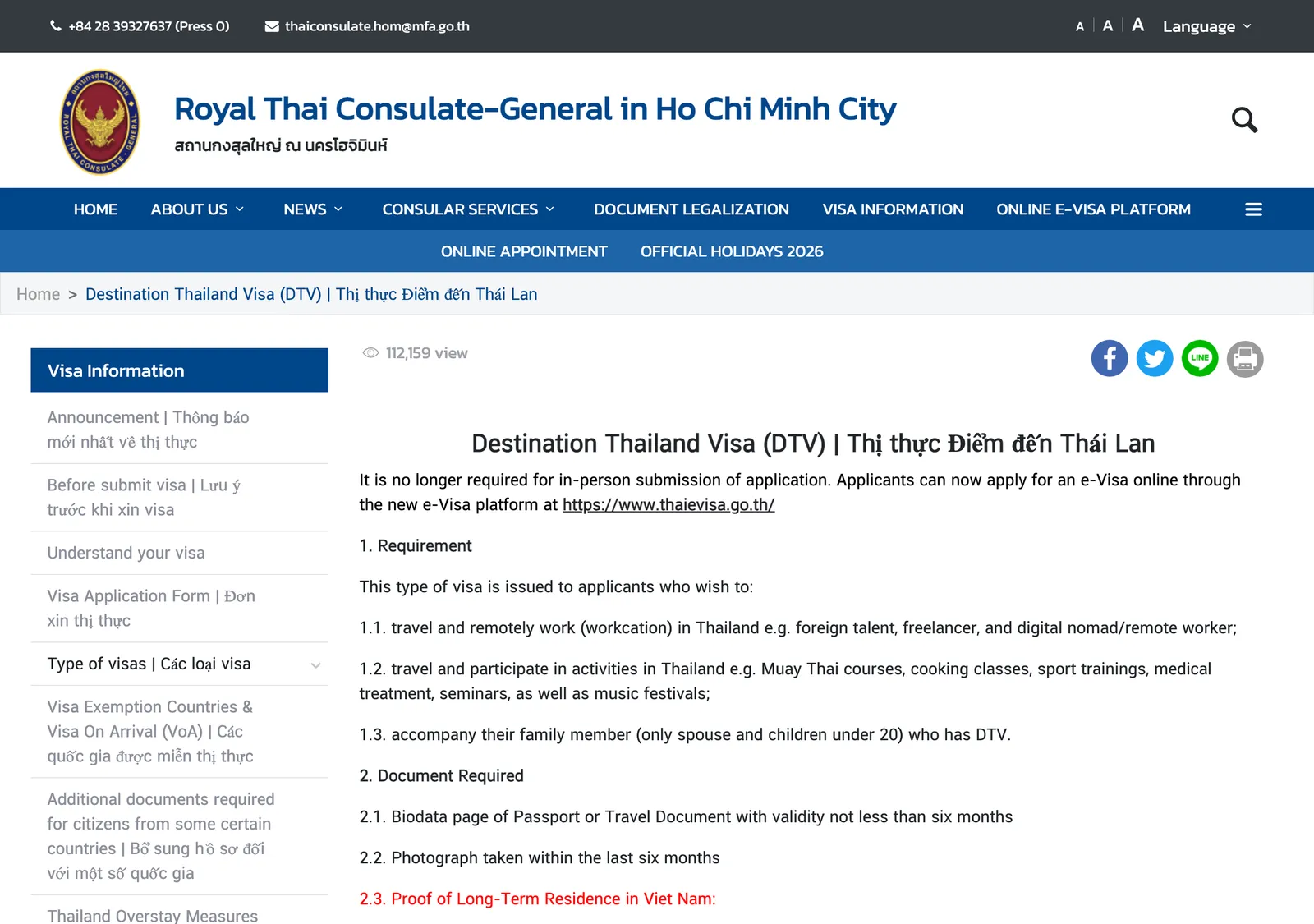
- Visa-exempt entry: tourism purposes only.
- DTV: remote work is a listed purpose. Applicants show at least THB 500,000 in funds, and each entry gives a stay of up to 180 days. Holders cannot get a Thai work permit, and cannot work for companies in Thailand or freelance for Thai clients.
- LTR, Work-from-Thailand Professionals: remote workers working for well-established overseas companies. Work permits are not granted to this category.
The DTV’s 180-day stay and the 180-day tax test are separate rules. The first caps one visit. The second counts every day in Thailand between 1 January and 31 December, so one full 180-day DTV stay already makes you a resident for that year.
The DTV and LTR have their own pages: DTV costs and steps and LTR categories. The visa exemption rules cover who enters visa-free.
What the work permit rule says
Section 8 of the Foreigners’ Working Management Emergency Decree, as replaced in 2018, prohibits a foreigner from working without a work permit or beyond what the permit allows.
ห้ามคนต่างด้าวทำงานโดยไม่มีใบอนุญาตทำงานหรือทำงานนอกเหนือจากที่มีสิทธิจะทำได้อันเป็นการฝ่าฝืนพระราชกำหนดนี้
Editor’s translation, not the official text: “A foreigner is prohibited from working without a work permit or working beyond what he or she is entitled to do, in violation of this Emergency Decree.”
Emergency Decree (No. 2) B.E. 2561, section 8, Royal Gazette 27 March 2018
The Decree defines work as practising any occupation, whether or not there is an employer. The definition excludes the business of licence holders under the Foreign Business law.
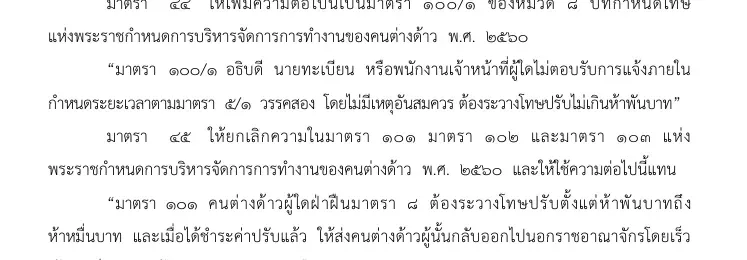
A foreigner who breaks section 8 is liable to a fine and is then sent out of the Kingdom promptly, with exceptions for some categories of foreigner. The fine range is THB 5,000–50,000.
คนต่างด้าวผู้ใดฝ่าฝืนมาตรา ๘ ต้องระวางโทษปรับตั้งแต่ห้าพันบาทถึงห้าหมื่นบาท และเมื่อได้ชำระค่าปรับแล้ว ให้ส่งคนต่างด้าวผู้นั้นกลับออกไปนอกราชอาณาจักรโดยเร็ว
Editor’s translation, not the official text: “A foreigner who violates section 8 is liable to a fine of 5,000 to 50,000 baht and, once the fine is paid, shall be sent out of the Kingdom promptly…”
Emergency Decree (No. 2) B.E. 2561, section 45, new section 101
In practice, the DTV is the status that lists remote work as a purpose, and visa-exempt entry is stated as tourism only. Remote work for a foreign employer fits the DTV. A job for a Thai company or Thai clients does not.
Are you a Thai tax resident?
The Revenue Department defines a person in Thailand as someone in Thailand a total of 180 days or more between 1 January and 31 December. Section 41 treats anyone in Thailand for periods totalling 180 days in a tax year as resident.
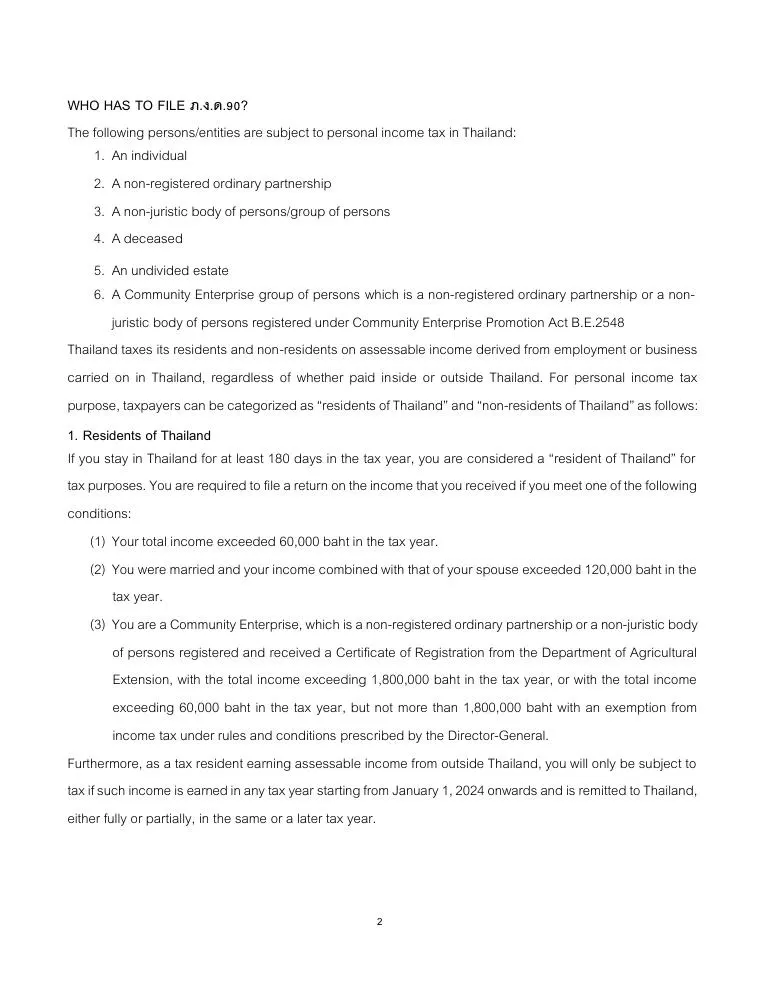
- One stay or several stays both count.
- The test ignores nationality or ethnicity.
- Someone in Thailand 179 days in a tax year is not a resident for that year.
- A stay across two years counts per year.
- A person in Thailand fewer than 180 days is a non-resident, and files PND 90 if they have Thai-taxable income and meet the same income conditions.
The full test, with the Revenue Department examples, is in Thailand tax residency and foreign income.
Which income Thailand taxes
Two rules apply to a remote worker. One covers money earned abroad and brought in. The other covers work done in Thailand.
Foreign income you bring in
Order Por. 161/2566 says a resident with foreign-source assessable income who brings it into Thailand in any tax year includes it in that year’s tax computation.
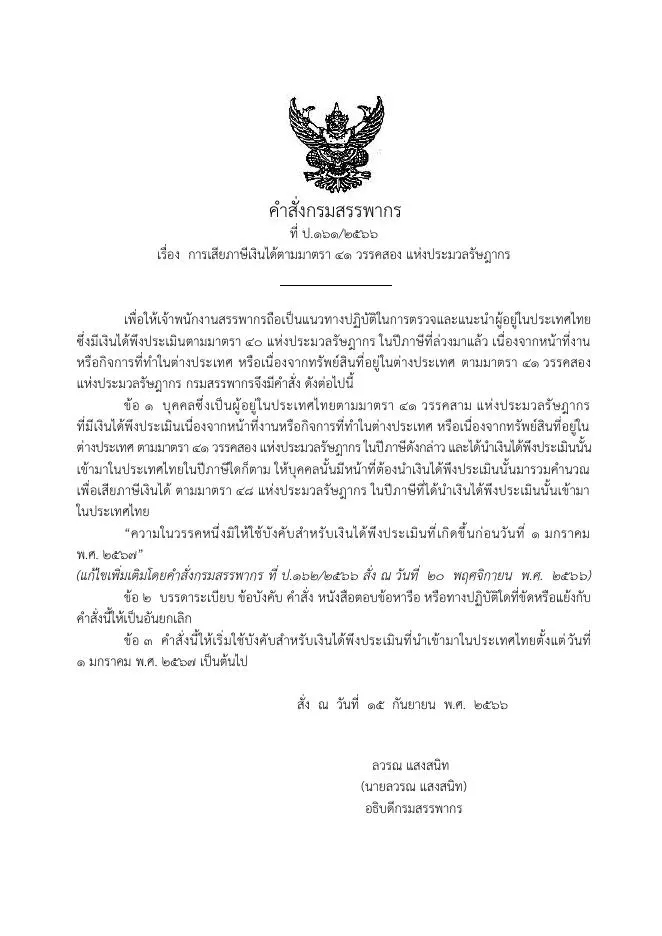
The order applies to income brought into Thailand from 1 January 2024. Order Por. 162/2566 amended it so the rule does not reach income that arose before 1 January 2024.
- Income earned from 2024 in a year you were in Thailand 180 days or more is taxed when you bring it in that year or later.
- Foreign income of a year with fewer than 180 days in Thailand is not taxed, even if brought into Thailand.
- Income received before 2024 and brought in during 2024 is not taxed, because it arose before 1 January 2024.
- Savings built abroad in years you were in Thailand fewer than 180 days can come in without tax.
- Convert foreign income at the rate on the day it is brought into Thailand.
Work done in Thailand
Under Revenue Code section 41 paragraph 1, income from work or business done in Thailand is taxable in Thailand whether it is paid inside or outside the country. Paragraph 2 covers a resident’s income from work done abroad, taxed when brought into Thailand. The foreign-income rules above reach only pay for days you work outside Thailand. Pay for days you work in Thailand is Thai-source whoever pays it.
Long-Term Resident visa: the exemption
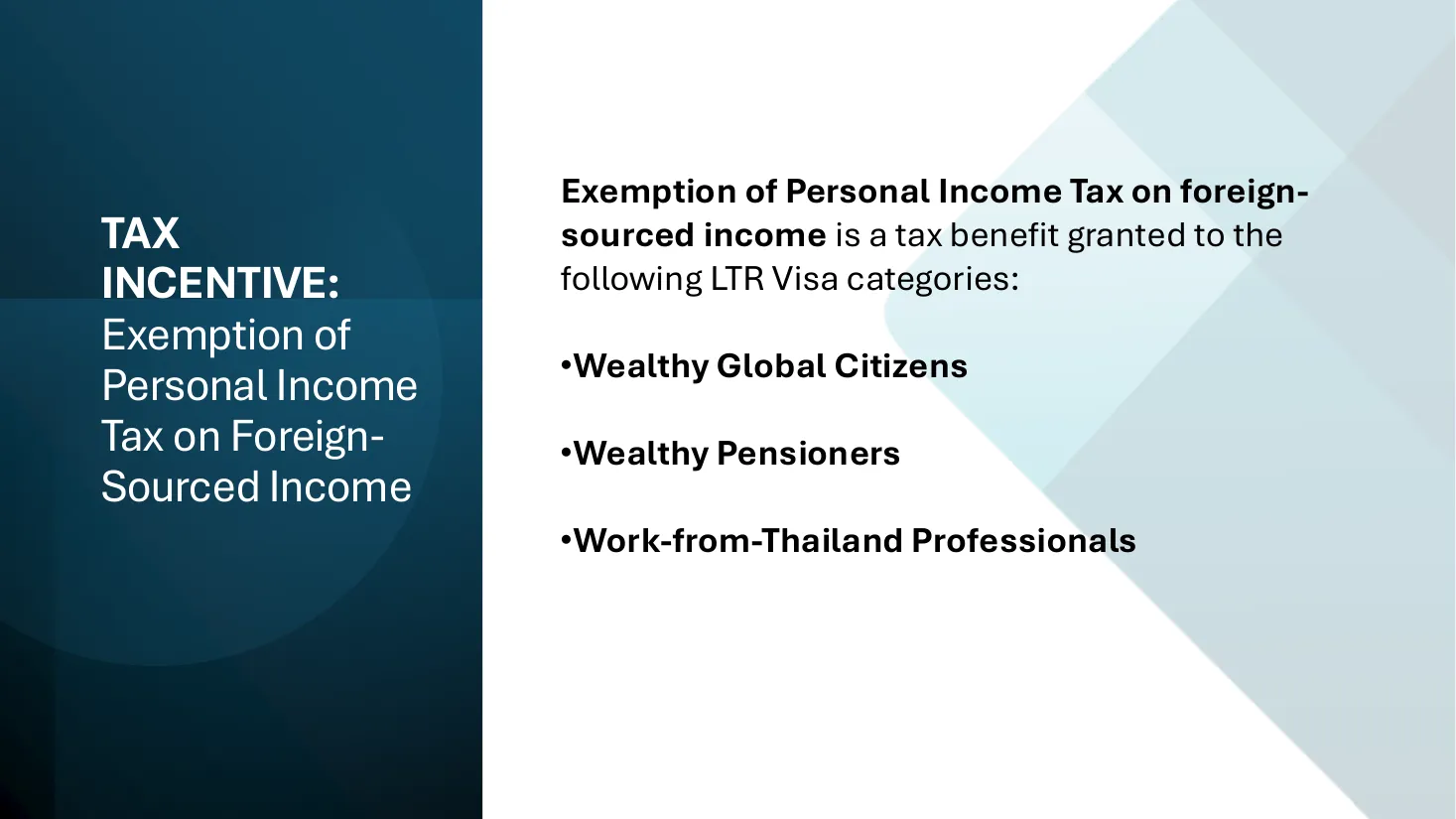
The Revenue Department presents the exemption from personal income tax on foreign-sourced income as granted to three LTR categories: Wealthy Global Citizens, Wealthy Pensioners and Work-from-Thailand Professionals. Tax exemption for overseas income is among the LTR privileges.
- The exemption needs no application or prior approval.
- An LTR holder with no domestic-sourced income besides foreign income remitted into Thailand does not need to file a personal income tax return.
- An LTR holder with domestic-sourced income must file a return.
- The 17% flat rate on employment income is for Highly-Skilled Professionals who work for a company in a targeted industry.
Tax rates and deductions
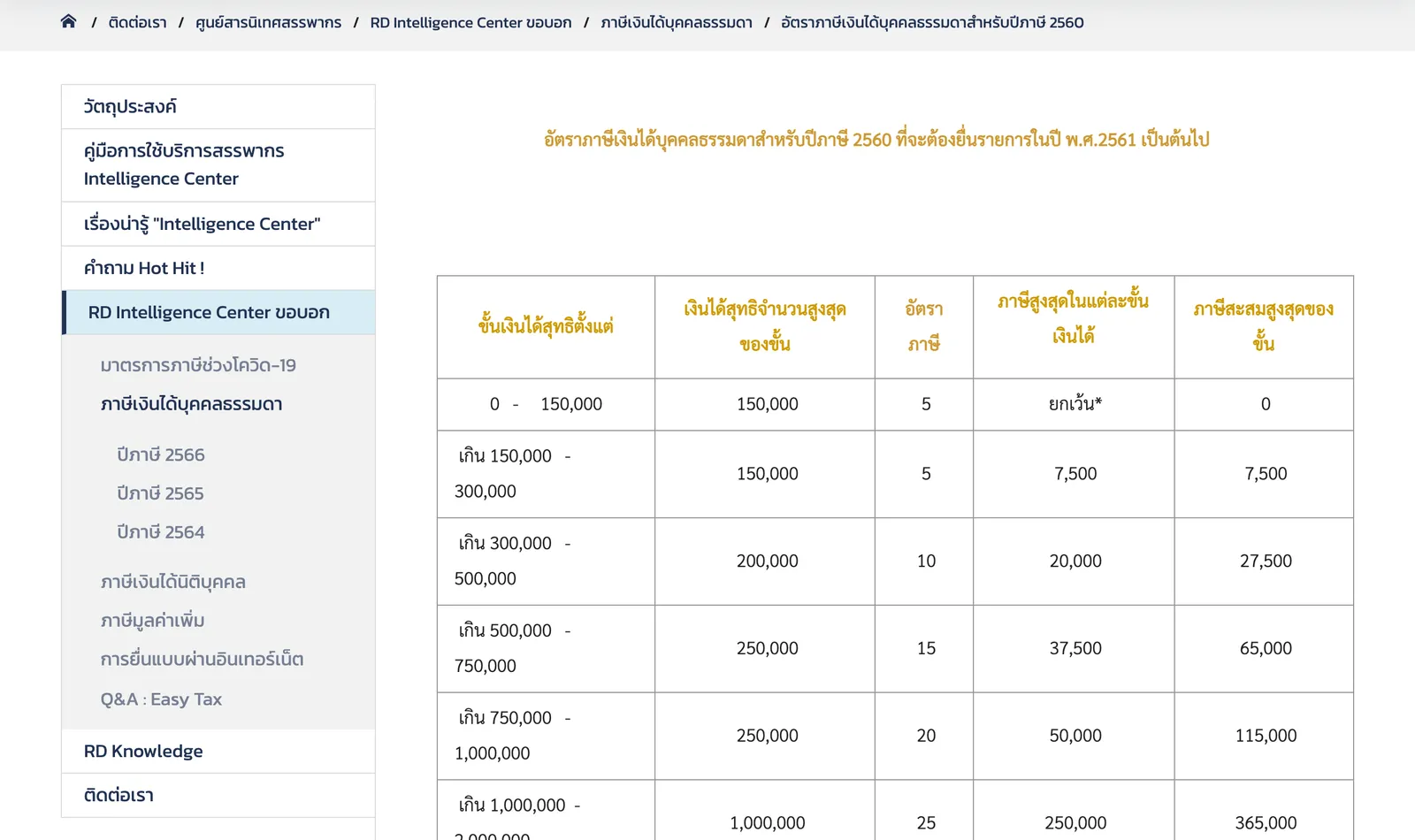
Thai personal income tax uses bands on net income. The first THB 150,000 is exempt.
| Net income (THB) | Rate |
|---|---|
| Up to 150,000 | 0% |
| 150,000–300,000 | 5% |
| 300,000–500,000 | 10% |
| 500,000–750,000 | 15% |
| 750,000–1,000,000 | 20% |
| 1,000,000–2,000,000 | 25% |
| 2,000,000–5,000,000 | 30% |
| Over 5,000,000 | 35% |
For employment income the guide lets a taxpayer deduct expenses equal to 50% of the income, up to 100,000 baht. Its worked example uses a personal allowance of 60,000 baht.
Get a tax ID, file and pay
- Get a tax ID number. A foreigner with no personal identification number applies for a taxpayer identification number. The application is due within 60 days of the date the person derives assessable income, on Form L.P. 10.1.
- Check the income test. A resident files if total income in the tax year exceeded 60,000 baht, or 120,000 baht combined with a spouse.
- File. PND 90 is the general return, and someone with employment income only uses PND 91. For tax year 2025 the dates were 1 January to 31 March 2026 on paper and 8 April 2026 through e-Filing. Dates for tax year 2026 are not announced yet.
- Half-year return if you freelance. PND 94 is for section 40(5), (6), (7) and (8) income. The tax calendar lists 8 October as its e-Filing deadline.
- Pay or use instalments. Tax of 3,000 baht or more may be paid in 3 equal instalments. Late payment brings a surcharge of 1.5% per month.
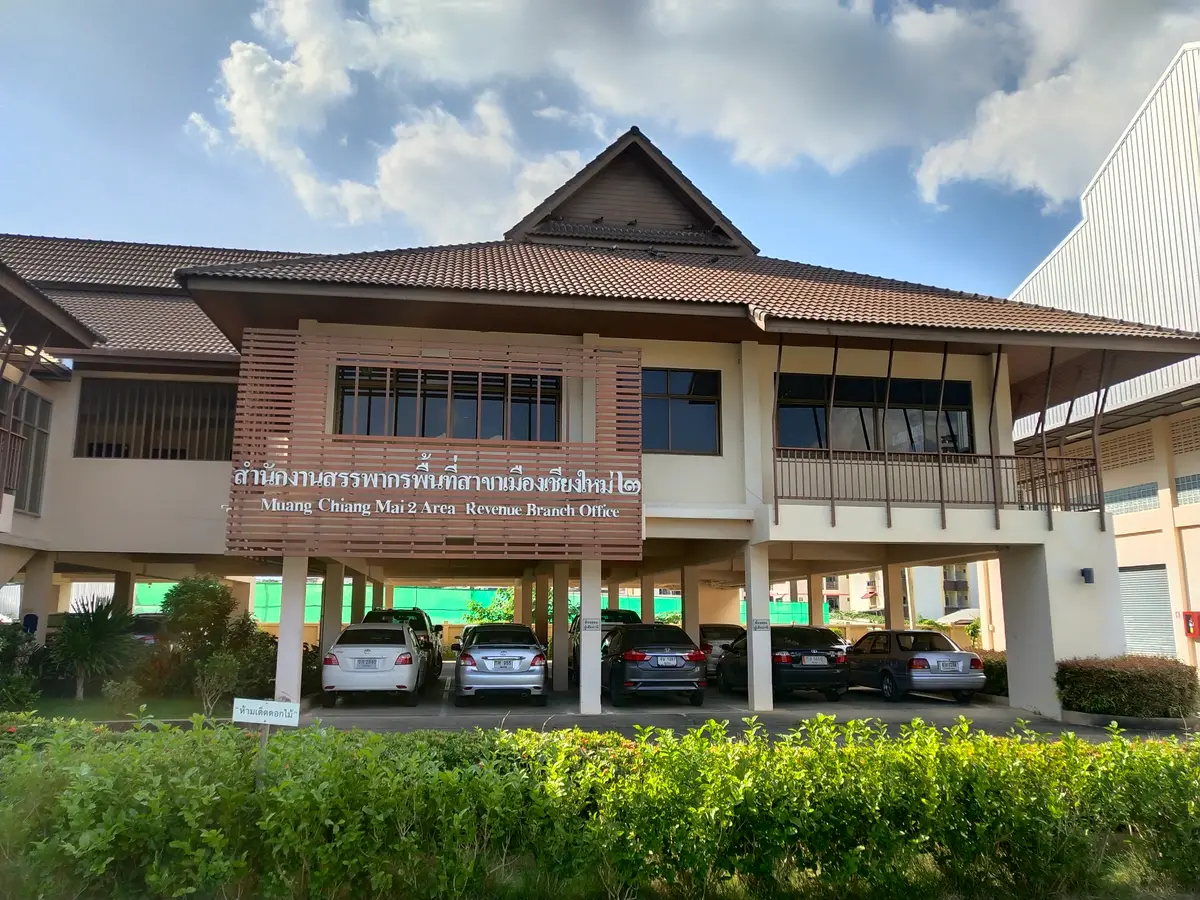
The Chiang Mai Area Revenue Branch Office 1-2 is at 2 4 Charoen Prathet Rd, Tambon Chang Khlan. Its telephone number is +66 53 284 172.
2 4 Charoen Prathet Rd, Tambon Chang Khlan, Mueang Chiang Mai District, Chiang Mai 50100, Thailand · Open in Google Maps (opens in a new tab)
A double tax agreement does not replace the filing duty. Where the Revenue Code and an agreement differ, the rate more beneficial to the taxpayer applies. Agreements use credit and exemption methods to remove double taxation.
Photo credits
- Photos and clips uploaded to Google Maps (Chiang Mai Area Revenue Branch Office 1-2 on Google Maps (opens in a new tab)) by Ampa Jaroenwung.
Step by step
- Check your statusVisa-exempt entry is for tourism purposes only. The DTV is issued to people who want to work remotely.
- Count your daysCount the days in Thailand between 1 January and 31 December.
- Sort your foreign incomeIncome earned from 1 January 2024 and brought into Thailand by a resident is taxed.
- Get a tax ID numberA foreigner with no personal identification number applies for a taxpayer identification number.
- File and payFile PND 90, or PND 91 for employment income only. Tax of 3,000 baht or more may be paid in 3 instalments.
Not confirmed: How the Revenue Department applies section 41 to pay from a foreign employer for days worked in Thailand is not published. Plan to treat those days as Thai-source income. Tax year 2026 filing dates are not announced yet.
Reach readers planning life in Chiang Mai. Advertise → hello@chiangmaijao.com
Common questions
Do I need a work permit for remote work on a DTV?
A DTV holder neither needs nor can get a Thai work permit. The DTV is issued for remote work, but holders are prohibited from obtaining a Thai work permit or working for Thai companies or Thai clients. For the LTR remote-worker category, work permits are not granted.
What is the penalty for working without a permit?
Foreign workers without permits, or outside permitted roles, face fines of THB 5,000–50,000 and deportation. The Decree text provides for the same fine and prompt removal from the Kingdom.
Does a DTV exempt my foreign income from Thai tax?
The foreign income exemption applies to three LTR categories. The DTV is not one of the four LTR categories.
Is foreign income taxed if I stay under 180 days in a year?
A person in Thailand fewer than 180 days in the tax year is not taxed on foreign income of that year, even if it is brought into Thailand. Someone in Thailand 179 days is not a resident for that year.
Do my days add up across two calendar years?
Days count per calendar year. In the Revenue Department example, a later stay of 150 days falls in the next year, and the person is not a resident in either year.
Do I need a tax ID number?
A foreigner with no personal identification number must apply for a taxpayer identification number. A foreigner present for one period of up to 14 days and up to 90 days in total in a tax year does not need to.
Which exchange rate converts foreign income?
Use the rate on the day the income is brought into Thailand.
Does my home-country tax change?
Where the Revenue Code and a double tax agreement differ, the rate more beneficial to the taxpayer applies. Agreements use credit and exemption methods.
Read next
General information checked against the sources listed above, not legal advice for your situation. Rules and office practice change; confirm with the immigration office or a licensed adviser before you act. See how guides are checked.
Spotted an error? Report it.