Thailand Tax Residency and Foreign Income Explained
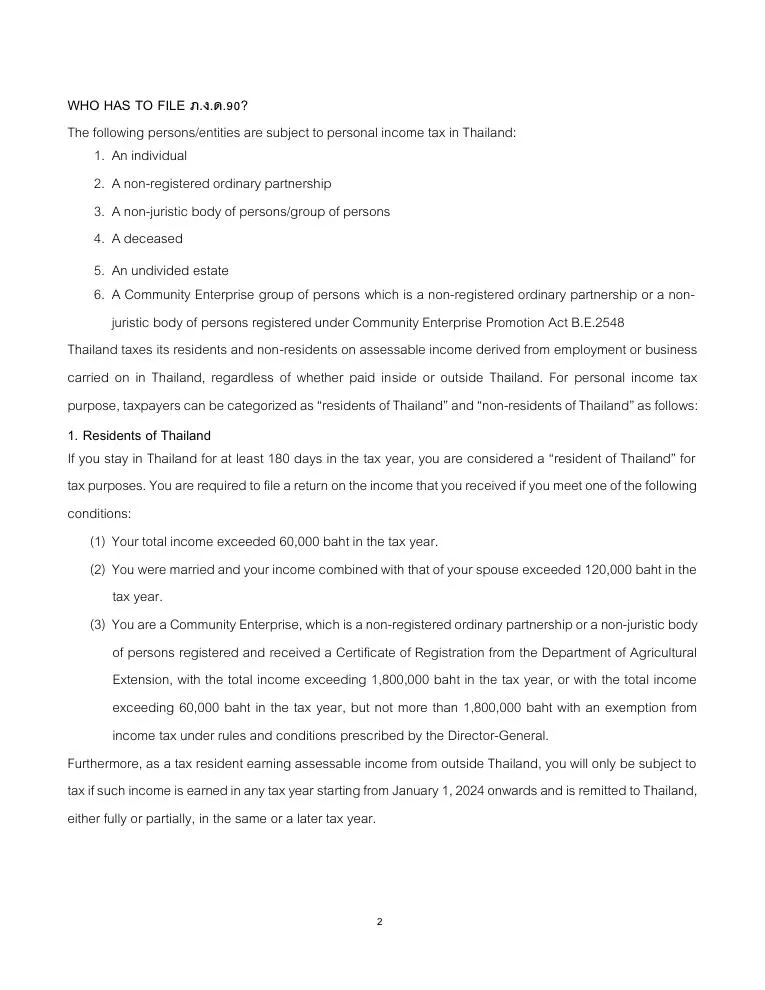
Anyone in Thailand 180 days or more in a calendar year is a tax resident for that year. A resident is taxed on foreign income earned from 1 January 2024 when it is brought into Thailand. Income that arose before 2024 is not taxed when brought in. Under 180 days, none is taxed.
On this page
The count starts on 1 January. Reach 180 days in Thailand by 31 December and you are a tax resident for that year. That status decides whether money you bring in from abroad is taxed.
Are you a Thai tax resident?
The Revenue Department defines a person in Thailand as someone in Thailand for a total of 180 days or more between 1 January and 31 December. One stay or several stays both count. The test ignores nationality.
Section 41 of the Revenue Code says anyone in Thailand for a period or periods totalling 180 days in a tax year is treated as resident. The tax year is the calendar year. The Revenue Department ties foreign income to the tax year in which you were in Thailand 180 days or more. In its example, 200 days in tax year 2024 counts for the whole year.
- Someone in Thailand 179 days in a tax year is not a resident for that year.
- A stay that spans two years counts per year. In the Revenue Department example, a later stay of 150 days falls in the next year, and the person is a non-resident in both years.
- A person in Thailand fewer than 180 days is a non-resident. A non-resident with Thai-taxable income files PND 90 on the same income conditions as a resident.
- Those conditions are total income above 60,000 baht in the tax year, or above 120,000 baht combined with a spouse if married.
Income from work or business done in Thailand is taxed whether it is paid inside or outside the country.
Which foreign income is taxed
The remittance rule applies to income brought in from 1 January 2024. Order Por. 161/2566 says a resident who brings foreign-source income into Thailand in any tax year includes it in their Thai tax computation.
เข้ามาในประเทศไทยในปีภาษีใดก็ตาม ให้บุคคลนั้นมีหน้าที่ต้องนำเงินได้พึงประเมินนั้นมารวมคำนวณ
Editor’s translation, not the official text: “…brought into Thailand in whichever tax year, that person must include that assessable income in the computation …”
Revenue Department Order Por. 161/2566, clause 1
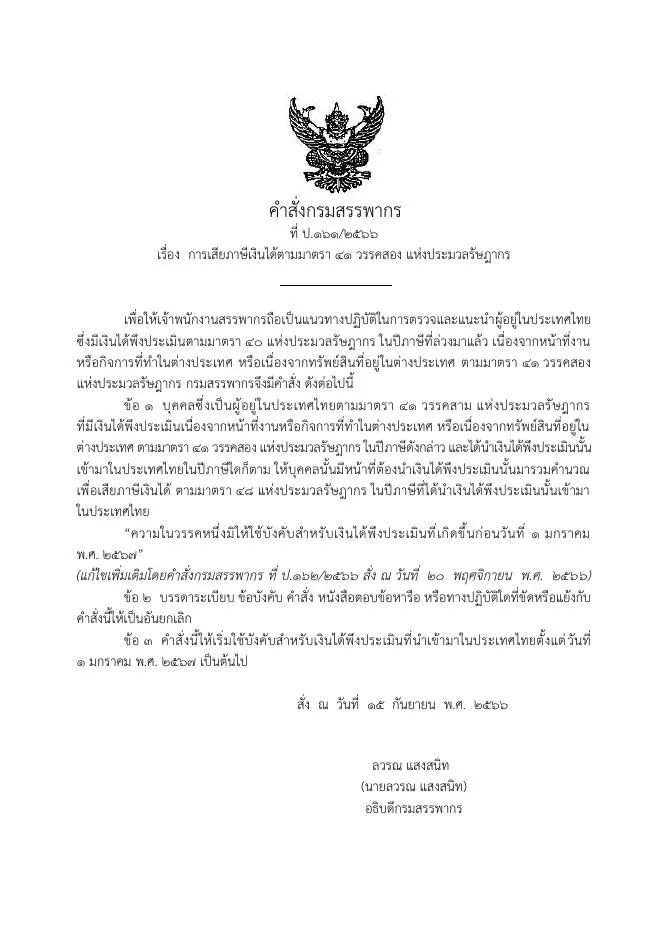
The order applies to income brought into Thailand from 1 January 2024. Order Por. 162/2566, dated 20 November 2023, amended it so the rule does not reach income that arose before that date.
Two conditions apply. The income is earned from 1 January 2024 in a year you were in Thailand 180 days or more. You bring it into Thailand in that year or in later years.
Savings from before 2024 and pensions
Income that arose before 1 January 2024 is not taxed when it is brought into Thailand, even in 2024 or later. In the Revenue Department example, bank interest that arose before 1 January 2024 is not taxed when brought in later.
Interest earned from 2024 is different, because it is assessable income when brought in. Keep bank records showing which year each amount arose.
A pension is listed in section 40(1). The remittance rule covers income under section 40(1) to (8). A foreign pension paid from 2024, in a year you were resident, falls within it once you bring it in.
What stays outside Thai tax
- Under 180 days, no personal income tax is due on foreign income of that year, even if you bring it back into Thailand.
- Savings built abroad in years you were in Thailand fewer than 180 days can come in without tax.
- The principal of a foreign deposit is not taxed when brought in, but the interest is assessable income.
- Convert foreign income at the exchange rate on the day it is brought into Thailand.
Keep bank records that show the date each transfer arrived. The conversion rate is the rate on that date.
Double tax treaties
A treaty does not replace the filing duty. When the Revenue Code and an agreement differ, the rate more beneficial to the taxpayer applies. Treaties use credit and exemption methods to remove double taxation.
A treaty covers income taxes, namely personal, corporate and petroleum income tax.
The day count is worded differently in each text. Revenue Code section 41 uses periods “totalling” 180 days. The Q&A uses “180 days or more”. The 2014 treaty introduction uses periods “exceeding in the aggregate 180 days”.
Section 41 governs Thai residency. The three wordings differ only for someone at exactly 180 days.
Tax rates and allowances
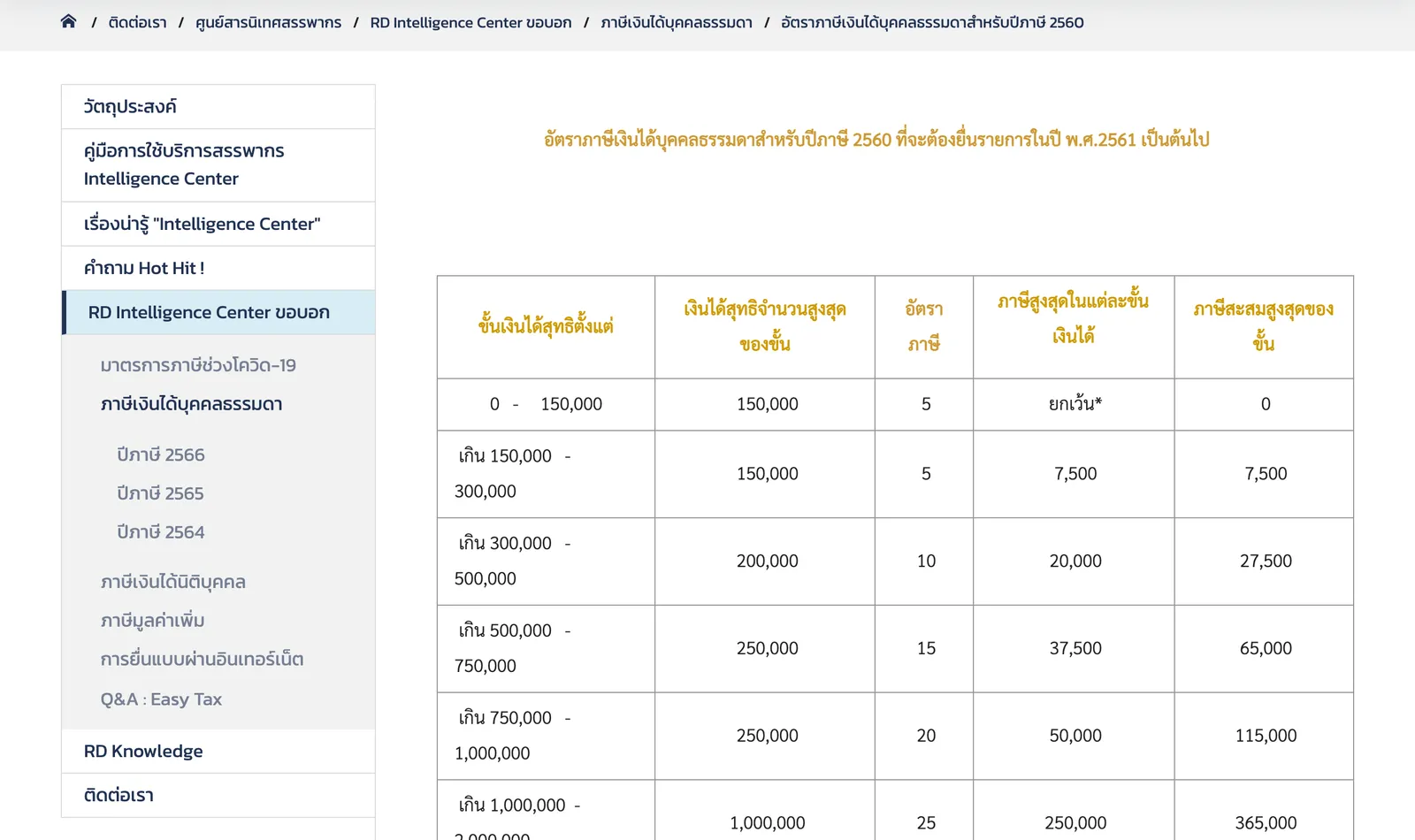
Rates apply to net income, after expenses and allowances. The Revenue Department table is headed for tax year 2017 onward, and the tax year 2024 guide has the same brackets.
| Net income (THB) | Rate |
|---|---|
| 0 to 150,000 | exempt |
| over 150,000 to 300,000 | 5% |
| over 300,000 to 500,000 | 10% |
| over 500,000 to 750,000 | 15% |
| over 750,000 to 1,000,000 | 20% |
| over 1,000,000 to 2,000,000 | 25% |
| over 2,000,000 to 5,000,000 | 30% |
| over 5,000,000 | 35% |
What reduces the bill
- A personal allowance of 60,000 baht appears in the English guide’s worked example.
- Employment income allows expenses of 50% of the income, up to 100,000 baht.
- A taxpayer aged 65 or older attaches the Income Exemption Entitlement Form for income exemption up to 190,000 baht.
- A minimum tax applies too. If gross assessable income, excluding employment income, is 120,000 baht or above, the tax is the greater of the net-income tax and 0.5 percent of total assessable income.
File PND 90 or PND 91
PND 90 (ภ.ง.ด.90) is the general return for income in the tax year. Someone with income from employment only must use PND 91. A resident must file if total income exceeded 60,000 baht, or if married and combined income exceeded 120,000 baht.
The return for tax year 2025 was due from 1 January to 31 March 2026 on paper. The Revenue Department has not published the dates for the next return yet.
| Return for tax year | Paper filing and payment | e-Filing deadline |
|---|---|---|
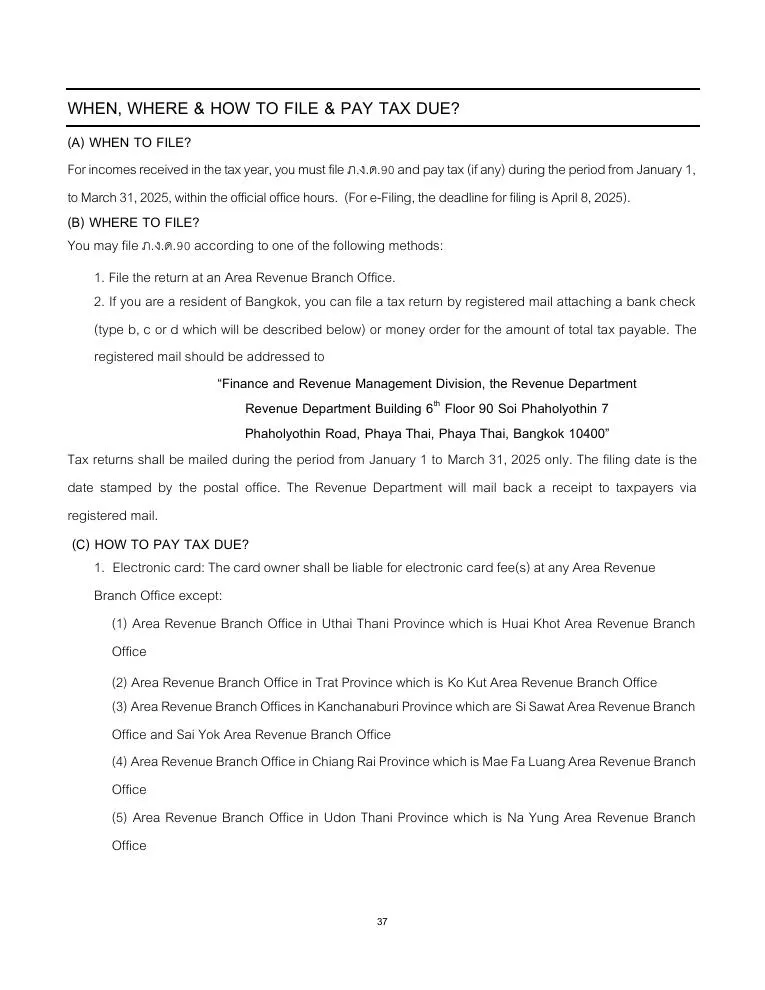
| 2024 | 1 January to 31 March 2025 | 8 April 2025 |
| 2025 | 1 January to 31 March 2026 | 8 April 2026 |
If you pay by instalments, the dates are 31 March, 30 April and 31 May.
Paper returns go to an Area Revenue Branch Office. Filing electronically at www.rd.go.th (opens in a new tab) gives an eight-day automatic deadline extension.
If the tax payable is at least 3,000 baht, you may ask to pay in 3 equal instalments. A surcharge of 1.5% per month applies to unpaid tax after the deadline, and a criminal fine of up to 2,000 baht may follow.
Get a tax ID number and file in Chiang Mai
A foreigner liable to Thai personal income tax who has no personal identification number applies for a taxpayer identification number. A foreigner present in one period of up to 14 days and in total up to 90 days in a tax year does not apply.
- Apply within 60 days from the date you derive assessable income, on Form L.P. 10.1.
- Bring a photocopy of your passport or alien certificate.
- In provinces other than Bangkok, file at the area revenue branch office for your domicile, or at any area revenue office or branch.
The Chiang Mai Area Revenue Branch Office 1-2 is at 2 4 Charoen Prathet Rd, Tambon Chang Khlan, Mueang Chiang Mai District, Chiang Mai 50100. Its telephone is +66 53 284 172. Paper filing runs within official office hours.

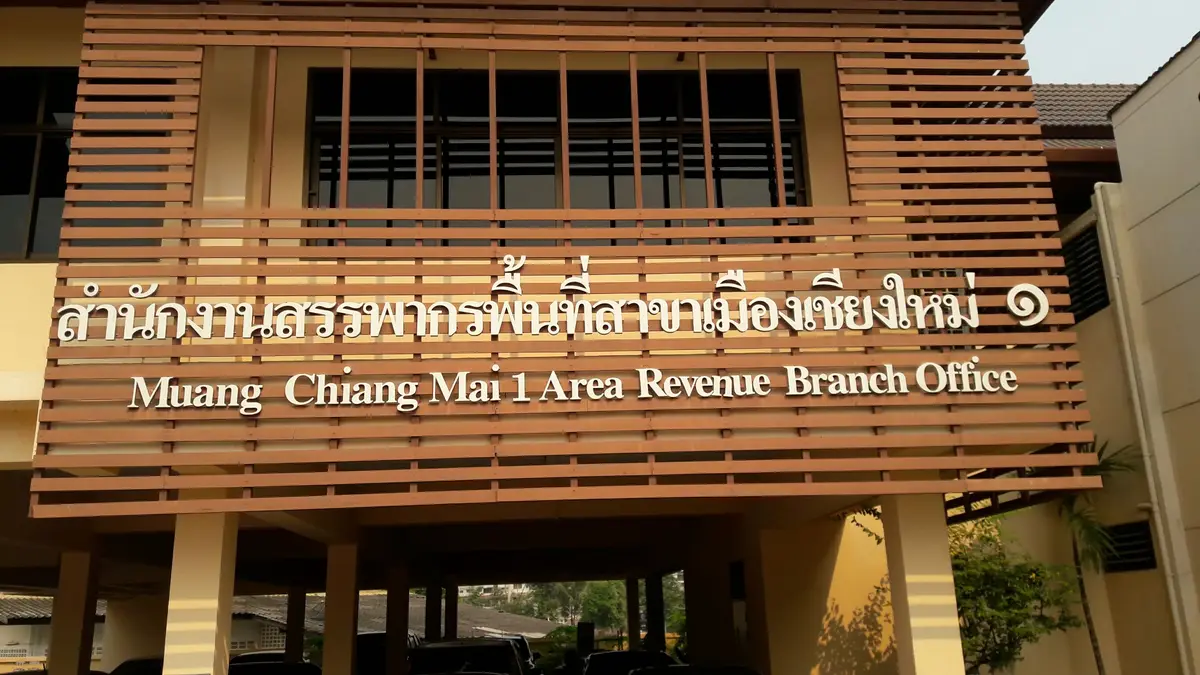
2 4 Charoen Prathet Rd, Tambon Chang Khlan, Mueang Chiang Mai District, Chiang Mai 50100, Thailand · Open in Google Maps (opens in a new tab)
Open in Google Maps (opens in a new tab)
Related guides: Thailand visa types, the cost of living in Chiang Mai and SIM and eSIM options.
Photo credits
- Photos and clips uploaded to Google Maps (Chiang Mai Area Revenue Branch Office 1-2 on Google Maps (opens in a new tab)) by Ampa Jaroenwung, Chai TNK.
Step by step
- Count your daysCount the days in Thailand between 1 January and 31 December.
- Sort your foreign incomeIncome earned abroad from 1 January 2024 and brought into Thailand in a year you were a resident is taxable.
- Get a tax ID numberA foreigner without a personal identification number applies for a taxpayer identification number.
- File the returnFile PND 90, or PND 91 for employment income only. For tax year 2025 the dates were 1 January to 31 March 2026 on paper and 8 April 2026 e-Filing.
- Pay or use instalmentsTax of 3,000 baht or more may be paid in 3 equal instalments.
Not confirmed: Next return: the Revenue Department has not published the filing dates, so check rd.go.th early next year. Foreign pensions: section 40(1) lists pensions, but this page found no Revenue Department text on how a treaty changes the result for one pension. A looser remittance rule reported by law firms is not an official order; Order Por. 161/2566 applies.
Reach readers planning life in Chiang Mai. Advertise → hello@chiangmaijao.com
Common questions
Do I pay Thai tax if I am in Thailand fewer than 180 days?
No Thai personal income tax is due on foreign income of that tax year, even if you bring it back into Thailand. Someone in Thailand 179 days in the tax year is not a resident for that year.
Do the 180 days have to be in one stay?
The Revenue Department counts one stay or several stays between 1 January and 31 December. A stay that spans two calendar years counts per year.
Does nationality matter for the 180-day test?
The test ignores nationality and ethnicity.
Is the money I saved abroad before moving taxed when I bring it in?
Income that arose before 1 January 2024 is not taxed when brought in, whatever year it arrives. Savings built abroad in years you were in Thailand fewer than 180 days can also come in without tax. The principal of a foreign deposit is not taxed, but its interest is assessable income.
Is a foreign pension taxed when I bring it into Thailand?
Section 40(1) lists pensions as employment income, and the Revenue Department applies the remittance rule to income under section 40(1) to (8). A pension paid from 2024 in a year you were resident and brought in is within the rule.
What are the filing dates for tax year 2025?
Paper filing ran from 1 January to 31 March 2026, and e-Filing until 8 April 2026.
Which exchange rate do I use for foreign income?
Use the rate on the date the income is brought into Thailand.
Do I file PND 90 or PND 91?
PND 90 is the general return, and someone with income from employment only uses PND 91.
What is the penalty for filing or paying late?
Late filing and payment carry a surcharge of 1.5% per month on the total tax due and a criminal fine of up to 2,000 baht.
Does a double tax treaty remove Thai tax?
If the Revenue Code and a treaty differ, the rate more beneficial to the taxpayer applies. Treaties use credit and exemption methods.
Read next
General information checked against the sources listed above, not legal advice for your situation. Rules and office practice change; confirm with the immigration office or a licensed adviser before you act. See how guides are checked.
Spotted an error? Report it.